
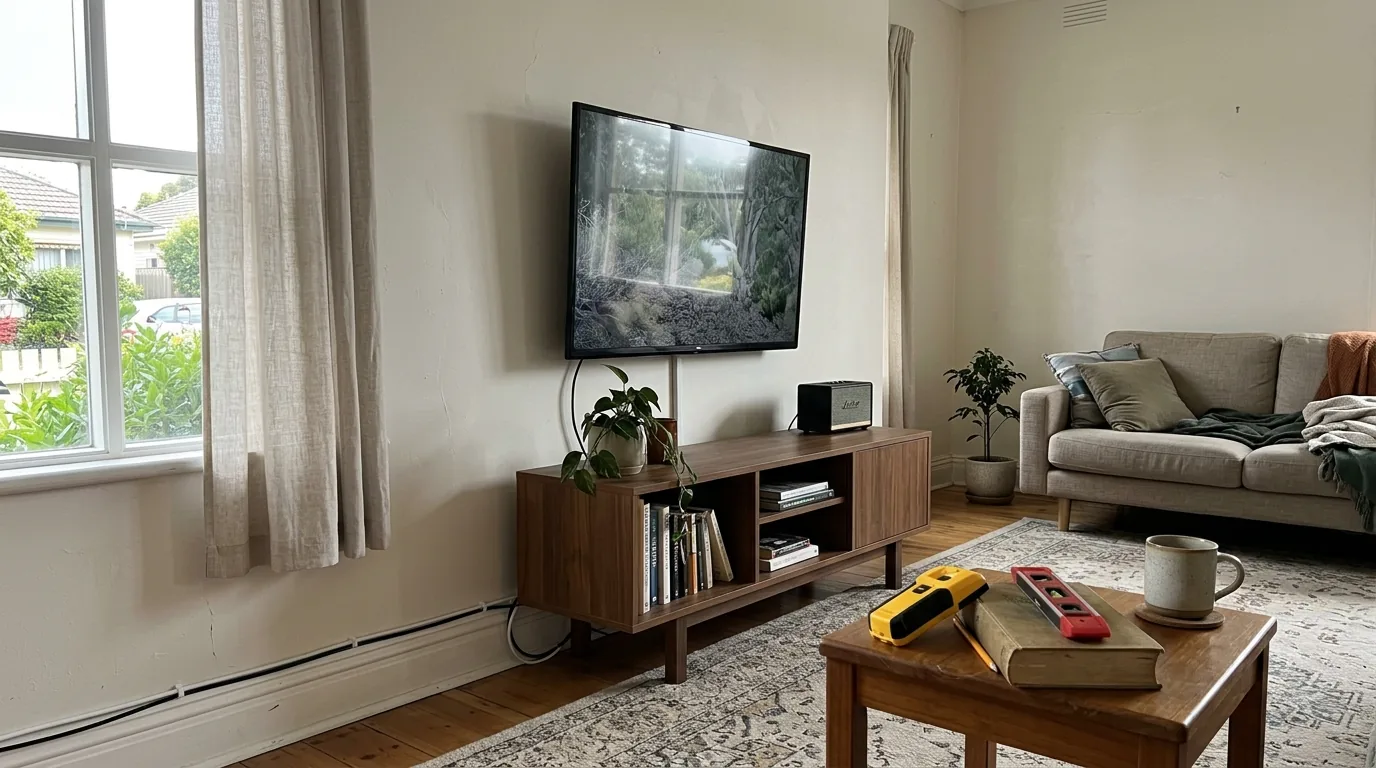
Plenty of people ask the same question before they buy a wall bracket: can I mount this TV myself, or is it worth paying someone to do it? The honest answer depends on your wall, your TV, and how tidy you want the cables to look.
If you have a standard plasterboard wall with a timber stud in a sensible spot, a lighter TV, and you’re happy for the cable to run down the wall in a cover, DIY is often doable. If you’re dealing with brick, concrete, a hollow section of wall, a heavy screen, or you want the cables hidden inside the wall, the job gets harder fast.
Quick guide
DIY and professional mounting compared
Wall type
DIY works well on standard plasterboard with a timber stud in the right spot. Brick, concrete and hollow areas usually need different fixings and tools.
Cable concealment
Surface cables are a simple DIY job. Running cables inside the wall cavity is trickier and can mean cutting and patching plasterboard.
TV size and weight
Smaller, lighter TVs on a fixed bracket are more forgiving. Larger screens on tilt or full-motion brackets put more strain on the fixing points.
Tools and fixings
A basic bracket kit covers plasterboard and studs. Brick, concrete or steel-framed walls often need different drill bits and anchors.
Finish and safety
A level, secure mount at a comfortable height is the goal either way. Getting it wrong on a heavy TV can mean a costly repair later.
What diy mounting actually involves
A basic DIY mount usually means finding a stud (or two, for wider brackets), drilling pilot holes, fixing the bracket to the wall, then lifting the TV onto it. If the cables are just going to sit in a cable cover on the surface, that’s the whole job.
Most bracket kits come with the hardware for plasterboard and timber studs. That covers a lot of Melbourne homes built with standard stud-and-plasterboard internal walls. The tricky part is usually finding the stud in the right place for where you want the TV, not the bracket itself.
Where diy mounting runs into trouble
The wall is the main variable. If your studs don’t line up with where you want the TV, you’re either moving the TV, using different fixings rated for plasterboard alone, or opening up the wall to add support. None of those are difficult in theory, but they take more skill and more tools than a straightforward stud fix.
Brick veneer walls, solid brick, and concrete need masonry bits, different anchors, and more care with drilling depth. Hollow or double-brick sections can also throw up surprises once you start drilling.
Cable concealment is the other common trip point. Running the power cable and any AV cables inside the wall cavity, rather than down the surface in a cover, usually means cutting an access hole behind the TV and another near a power point, then fishing the cable through. It’s a fiddly job, and if there’s insulation, noggins, or wiring already in the cavity, it gets harder.
Weight matters too. A small TV on a fixed bracket puts limited strain on the wall. A large screen on a tilting or full-motion arm puts a lot more leverage on the fixing points, especially if it’s pulled forward. Getting this wrong doesn’t always show up immediately. It can show up months later as a bracket working loose.
When it makes more sense to call a professional
If your wall isn’t straightforward plasterboard over timber studs, if you want the cables hidden inside the wall for a clean finish, or if you’re mounting a larger or heavier TV on a moving bracket, it’s worth weighing up a professional install against the time and risk of doing it yourself. A team that does this regularly will know how to handle brick, concrete, and awkward stud spacing, and how to conceal cabling properly without weakening the wall. If that sounds like your situation, it’s worth looking at what a TV Wall Mounting Melbourne service actually covers before you decide which way to go.
Hiding cables and adding a data point
Concealing power and AV cables inside the wall is one thing. Some households also want a hardwired network point behind the TV, particularly in double-brick or multi-storey homes where wifi doesn’t reach the lounge room reliably enough for streaming boxes or smart TV apps. That’s a separate job from mounting the TV itself, and it usually needs a proper data cabling run rather than just an extension cord tucked behind the bracket. If a wired connection behind the TV is something you’re considering, that’s the kind of work a Data Cabler Melbourne service would handle rather than a general mounting job.
What this means for cost
Wall type, bracket type, cable concealment, and TV size all affect how long the job takes and what it involves, which naturally affects what a professional install costs compared with a DIY attempt. If you want to understand what actually affects tv wall mounting cost, it helps to have those wall and cable details sorted first, since they’re the main things that change the quote.
Getting the height right either way
Whether you mount the TV yourself or get it done professionally, height matters just as much as how secure the fixing is. Mounting too high is one of the most common mistakes, and it’s hard to fix once the holes are drilled. Before you commit to a spot on the wall, it’s worth reading up on the best tv mounting height for a living room so you’re not stuck looking up at the screen every time you sit down.
If you’re still on the fence, a reasonable way to decide is to look honestly at your wall type, the TV’s weight, and how much you care about hidden cabling. Any one of those three being awkward is usually enough reason to get a second opinion before you start drilling.